Part 3: From Reading and Arithmetic to Therapy and Activism
There was a time when the purpose of a school could be stated without embarrassment. Children were sent there to learn to read, to write, to count, to know something of the world that existed before they arrived, and to acquire habits of mind that would serve them when novelty had lost its charm. That purpose was neither narrow nor cruel. It was the very means by which a child was equipped for freedom. A boy who can read with understanding and reckon with accuracy is harder to deceive than one who has only learned the emotional vocabulary of the hour.
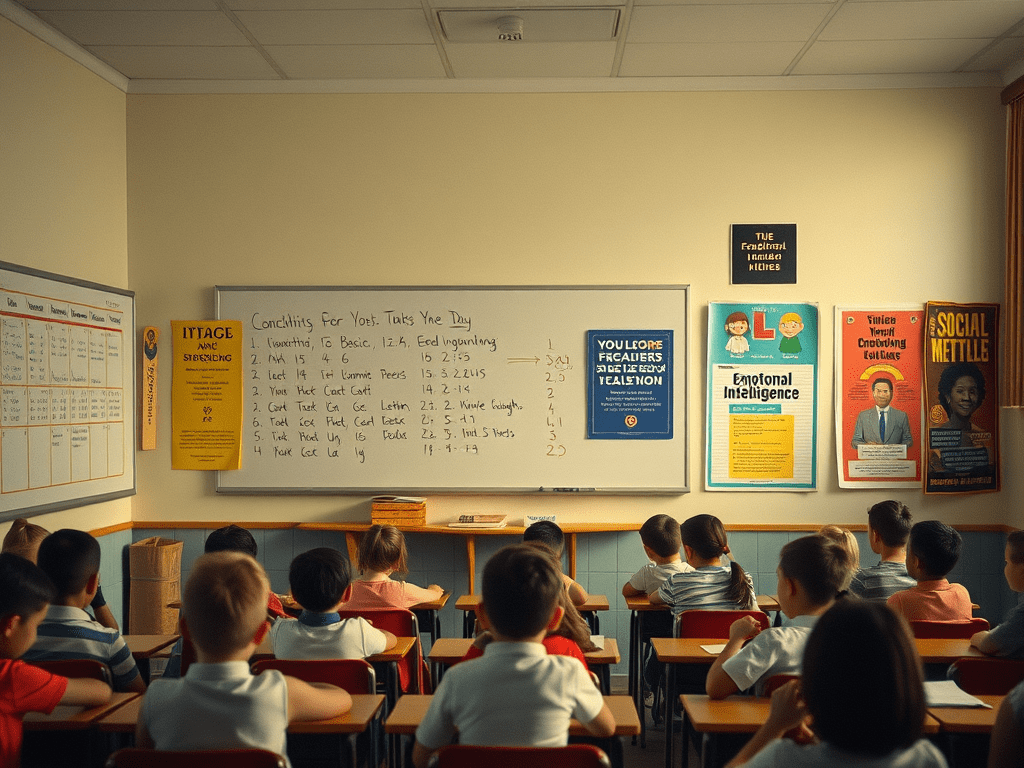
Yet much of modern education speaks in a different register. One hears less confidence about grammar, memory, mathematics, chronology, and logic, and far more confidence about identity, feelings, environments, social awareness, and personal development. Some of these matters have their place. Schools are inhabited by human beings, not machines. But once these secondary concerns begin to crowd out the primary work of intellectual formation, the institution begins to flatter the child rather than strengthen him.
The evidence of decline in the basics is not difficult to find. On the 2024 National Assessment of Educational Progress, the average fourth-grade reading score was 5 points lower than in 2019, and the average twelfth-grade reading score was 3 points lower than in 2019 and 10 points lower than in 1992. Fourth-grade mathematics rose modestly from 2022 to 2024, but still remained 3 points below 2019, while twelfth-grade mathematics in 2024 was 3 points lower than in 2019 and 3 points lower than in 2005. These are not the marks of a nation that has harmlessly diversified its educational aims. They are signs that the central work has weakened.
The deeper problem is not merely that scores are lower. It is that the lower scores coexist with an ever-expanding set of institutional ambitions. Social and emotional learning, or SEL, is now promoted through frameworks designed to cultivate “healthy identities,” emotional management, empathy, relationships, and responsible decision-making. CASEL, the best-known SEL organization, describes SEL as integral to education and human development and presents five core competencies at the center of its framework. Those goals may sound humane, and parts of them plainly are. But the question is not whether empathy and self-control are good things. The question is what happens when schools begin to speak as though such aims can compensate for weak reading, shaky writing, and inadequate mathematics. They cannot.
One must be careful here, because lazy criticism is easy. It would be foolish to argue that children’s emotional lives do not matter, or that schools should ignore conduct, character, or the realities of suffering. No sensible teacher has ever believed such things. The argument is more exacting than that. When schools expand their mission so far that almost every human need becomes a school responsibility, they make serious instruction harder to protect. Time is finite. Attention is finite. Training is finite. An institution that attempts to become therapist, moral guide, identity workshop, social arbiter, and civic mobilizer all at once will often do the humbler work of teaching badly.
That pattern becomes still more troubling when one observes how readily social and political topics now enter classroom life. RAND’s 2025 report on K to 12 public schools found that teachers reported instruction on ten social and political topics, including race, gender identity and expression, religion, immigration, and SEL, with substantial variation by subject, grade level, and state policy environment. The report itself does not prove indoctrination, and it should not be misused as though it does. But it does establish that classrooms are being asked to carry more than reading, arithmetic, and factual knowledge. The expansion is real. The question is whether schools have earned the right to take on these added burdens when the foundational burdens are being met so unevenly.
The defenders of this expansion usually speak as though the old academic core were too narrow for modern life. Children, they say, need more than facts. They need belonging, affirmation, social awareness, emotional fluency, and preparation for life in a complicated society. Fair enough, as far as it goes. But one should notice how often this language quietly assumes what it never proves, namely, that the mastery of reading, writing, mathematics, and historical knowledge is somehow less human than the newer therapies of institutional concern. In fact, the opposite is closer to the truth. Literacy is humanizing. Numeracy is humanizing. Knowledge of history is humanizing. To teach a child to read deeply is not to neglect his humanity, but to honor it.
There is also a class element in these fashionable substitutions that deserves more attention than it receives. Families with means can often compensate for weak schools. They can buy tutors, provide books, supervise homework, supply enrichment, and protect their children from institutional nonsense. It is the child without such advantages who suffers most when a school mistakes affirmation for education. He needs the school to do the plain thing well. He needs order, knowledge, correction, repetition, demanding texts, accurate numbers, and adults who care more about his intellectual growth than about fashionable institutional self-description. When schools drift from basics, the well-off may grumble. The vulnerable pay.
Critics of this argument will say that it creates a false choice. Why not teach the basics and also care for the whole child? In principle, there is nothing wrong with that aspiration. In practice, however, institutions reveal their priorities by what they protect when pressure comes. If reading declines, math stagnates, and the weakest students fall further behind, while the language of emotional frameworks and social programming grows ever more elaborate, then one is entitled to ask whether the so-called whole child has become a convenient excuse for neglecting the intellectual child.
This is where therapy and activism begin to resemble each other more than their advocates might wish to admit. Both can displace the discipline of truth with the management of sentiment. Therapy, when overextended into institutional life, teaches the child to interpret discomfort as a central educational fact. Activism, when overextended into institutional life, teaches the child to interpret social alignment as a mark of moral seriousness. Both flatter emotion. Neither can replace the stern mercy of being taught what is true, what is false, what happened, how numbers work, and how language carries meaning.
A school should not be cold. It should not be indifferent to grief, cruelty, fear, or loneliness. But neither should it pretend that emotional framing is a substitute for intellectual formation. Children do not become strong because adults keep describing their feelings back to them. They become stronger when they are taught to master language, follow arguments, solve problems, remember what matters, and persevere through difficulty. The school that abandons those tasks in favor of endless therapeutic or ideological expansion has not become more compassionate. It has become less useful.
That is the heart of the matter. Reading and arithmetic are not relics of an older and harsher age. They are civilizational necessities. A child who cannot read well is easily manipulated. A child who cannot calculate is easily misled. A child who knows no history is easily recruited into whatever moral drama the present moment chooses to invent. If schools wish to care for children, they might begin by refusing to deprive them of the very tools by which they could resist confusion, dependency, and deceit.
The decline from fundamentals to fashionable substitutes is not merely a curricular mistake. It is a moral mistake. It takes those who most need substance and gives them atmosphere instead. It takes those who need knowledge and gives them posture. And it leaves behind a generation that may know how to speak about feelings, identity, and causes, yet still lack the hard-won powers that make liberty possible. A school that cannot keep first things first will eventually lose even the second things it meant to gain.
Notes
- National Assessment of Educational Progress, “Explore Results for the 2024 NAEP Reading Assessment,” The Nation’s Report Card, National Center for Education Statistics, accessed March 10, 2026, https://www.nationsreportcard.gov/reports/reading/2024/g4_8/.
- National Assessment of Educational Progress, “NAEP Report Card: Grade 12 Reading,” The Nation’s Report Card, National Center for Education Statistics, accessed March 10, 2026, https://www.nationsreportcard.gov/reports/reading/2024/g12/.
- National Assessment of Educational Progress, “Explore Results for the 2024 NAEP Mathematics Assessment,” The Nation’s Report Card, National Center for Education Statistics, accessed March 10, 2026, https://www.nationsreportcard.gov/reports/mathematics/2024/g4_8/.
- National Assessment of Educational Progress, “NAEP Report Card: Grade 12 Mathematics,” The Nation’s Report Card, National Center for Education Statistics, accessed March 10, 2026, https://www.nationsreportcard.gov/reports/mathematics/2024/g12/.
- CASEL, “What Is SEL?” CASEL Schoolguide, accessed March 10, 2026, https://schoolguide.casel.org/what-is-sel/what-is-sel/.
- CASEL, “CASEL’s SEL Framework,” accessed March 10, 2026, https://casel.org/casel-sel-framework-11-2020/.
- Ashley Woo et al., Instruction About Social and Political Topics in K–12 Public Schools: Findings from the 2024 State of the American Teacher Survey (Santa Monica, CA: RAND Corporation, 2025), accessed March 10, 2026, https://www.rand.org/pubs/research_reports/RRA1108-14.html.
Bibliography
CASEL. “CASEL’s SEL Framework.” Accessed March 10, 2026. https://casel.org/casel-sel-framework-11-2020/.
CASEL. “What Is SEL?” CASEL Schoolguide. Accessed March 10, 2026. https://schoolguide.casel.org/what-is-sel/what-is-sel/.
National Assessment of Educational Progress. “Explore Results for the 2024 NAEP Mathematics Assessment.” The Nation’s Report Card. National Center for Education Statistics. Accessed March 10, 2026. https://www.nationsreportcard.gov/reports/mathematics/2024/g4_8/.
National Assessment of Educational Progress. “Explore Results for the 2024 NAEP Reading Assessment.” The Nation’s Report Card. National Center for Education Statistics. Accessed March 10, 2026. https://www.nationsreportcard.gov/reports/reading/2024/g4_8/.
National Assessment of Educational Progress. “NAEP Report Card: Grade 12 Mathematics.” The Nation’s Report Card. National Center for Education Statistics. Accessed March 10, 2026. https://www.nationsreportcard.gov/reports/mathematics/2024/g12/.
National Assessment of Educational Progress. “NAEP Report Card: Grade 12 Reading.” The Nation’s Report Card. National Center for Education Statistics. Accessed March 10, 2026. https://www.nationsreportcard.gov/reports/reading/2024/g12/.
Woo, Ashley, et al. Instruction About Social and Political Topics in K–12 Public Schools: Findings from the 2024 State of the American Teacher Survey. Santa Monica, CA: RAND Corporation, 2025. Accessed March 10, 2026. https://www.rand.org/pubs/research_reports/RRA1108-14.html.
 Seeking Truth in Today's Troubled World
Leave a comment