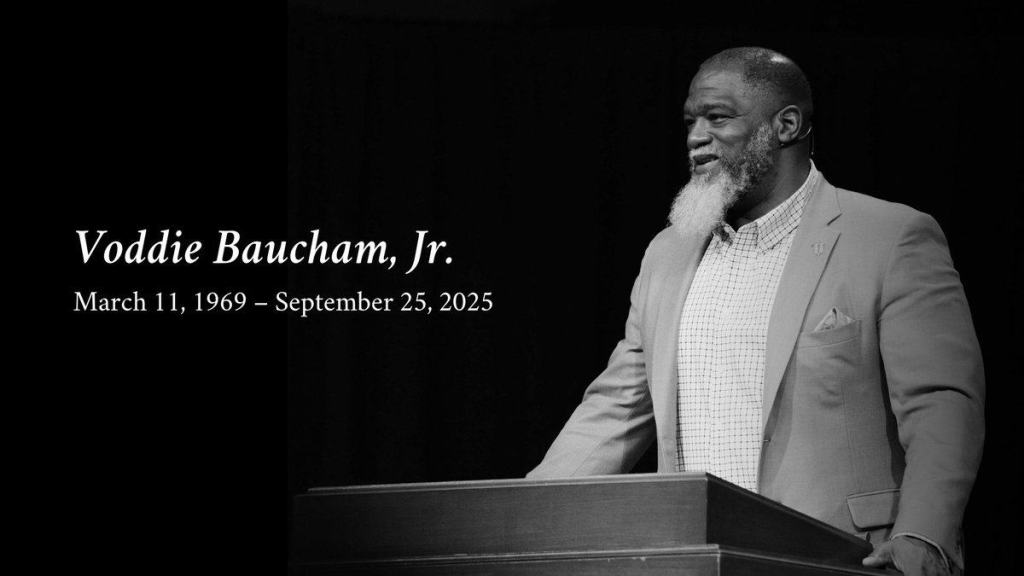
There are lives that thunder. There are others that ring like a tuning fork, steady and clear, so that all the instruments in the room find their pitch. Pastor Voddie’s life was the latter. He did not court applause. He tuned hearts to the note of God’s Word until the noise of our age sounded thin by comparison. His great project was not novelty but fidelity. Give him a pulpit, a text, and a people, and he would give you Christ.
He believed that the Bible is not a cabinet of curiosities but a living Word, and he handled it with a craftsman’s care. He taught us that truth is not harsh by nature, only sharp, and that a sharp blade in the hand of a loving surgeon is a mercy. Many of us learned to love expository preaching because he first loved it in front of us. He showed how doctrine steadies the home, dignifies the work week, braces the conscience, and anchors the soul when the storm comes in the night.
If you ask what he championed, the answer is simple. He was a herald of the Gospel of Jesus Christ. Not a trend, not an attitude, but the ancient message that God saves sinners through the atoning death and victorious resurrection of his Son; that repentance is not a seasonal fad but the doorway to life; that faith is not a vague optimism but trust in a Person who bled and rose and reigns. He believed that the church does not need the world’s permission to be the church, and that the Scriptures are not on trial before the culture. He preached Christ as Lord, and he did so with a boldness governed by reverence.
His courage, though, was never merely public. He was brave at home. There he was not an orator but a husband and a father, and he treated those callings as holy ground. He delighted in his bride. He believed that a man’s first congregation gathers around his own table. In an age that confuses provision with presence, he gave both. He measured success not by itinerary miles but by faithfulness within his own walls. Those who watched him closely saw a man who led with tenderness, repented with speed, and laughed without cynicism. He set his face like flint in the pulpit, and he set it like flint toward family worship, shared burdens, and everyday joys.
He also taught the rest of us how to be ordinary Christians in extraordinary times. He warned that ideas have consequences and that shepherds must guard the flock. Yet his warnings were the fruit of love, not suspicion. He called us to test every wind by the Word, to prefer wisdom over noise, and to keep a clean conscience before God and man. When controversies swirled, he reminded us that the truth needs no theatrics, only clarity and patience. When suffering visited him, he did not treat it as a scandal but as a stewardship. He did not waste his pain. He turned it into prayer, into witness, into the quiet insistence that our times are in the Lord’s hand.
Many were trained under his guidance, whether in classrooms, conferences, or living rooms. He regarded theological education as seed work. Plant it deeply, water it with prayer, and trust the Lord to give the harvest in due season. He wanted churches that would still be healthy when our grandchildren take their seats. He aimed long. He reminded us that the Great Commission is not fulfilled by enthusiasm alone, but by patient discipleship, sound teaching, and households that adorn the doctrine of God our Savior.
Today we grieve. Of course we do. Death is an enemy, though a defeated one, and it tears what love has bound. But our grief is braided with thanksgiving. We thank God for a preacher who refused to trim the truth to fit the times. We thank God for a husband who made covenant love visible. We thank God for a father who understood that raising children in the discipline and instruction of the Lord is not a side task but a royal one. We thank God for a brother who strengthened our hands and steadied our knees.
What shall we do with such a legacy? We should not curate it like a museum piece. We should carry it. Let husbands love their wives as Christ loved the church. Let fathers bring their children near and speak the Word over them with patience and joy. Let preachers open the Bible and say what God has said, neither less nor more. Let churches sing as those who know their Redeemer lives and let our lives be shaped by the same Gospel that shaped his.
There are questions we cannot answer today. There is, however, a Person we can trust. Pastor Voddie would want no monument larger than this: that we look to Jesus Christ, crucified and risen, and follow him with our whole heart. He would bid us hold fast to the faith once for all delivered to the saints, to resist the temptation to be clever when God calls us to be clear, and to remember that the fruit of our lives will grow from the root we nourish in secret.
So, we commend our brother to God and to the word of His grace, which is able to build us up and to give us the inheritance among all those who are sanctified. We commend his family to the Comforter, asking that the peace of Christ rule their hearts. And we commend ourselves to faithfulness in small things, to courage that is gentle, and to hope that does not fade.
“Blessed are the dead who die in the Lord.” They rest from their labors, and their works follow them. Thanks be to God for the life and witness of Pastor Voddie Baucham Jr., a servant of Jesus Christ, faithful to the Gospel, steadfast as a husband, and joyful as a father, who has now seen with his own eyes the King he preached.
In Christ’s service,
~JFH
 Seeking Truth in Today's Troubled World
Leave a comment