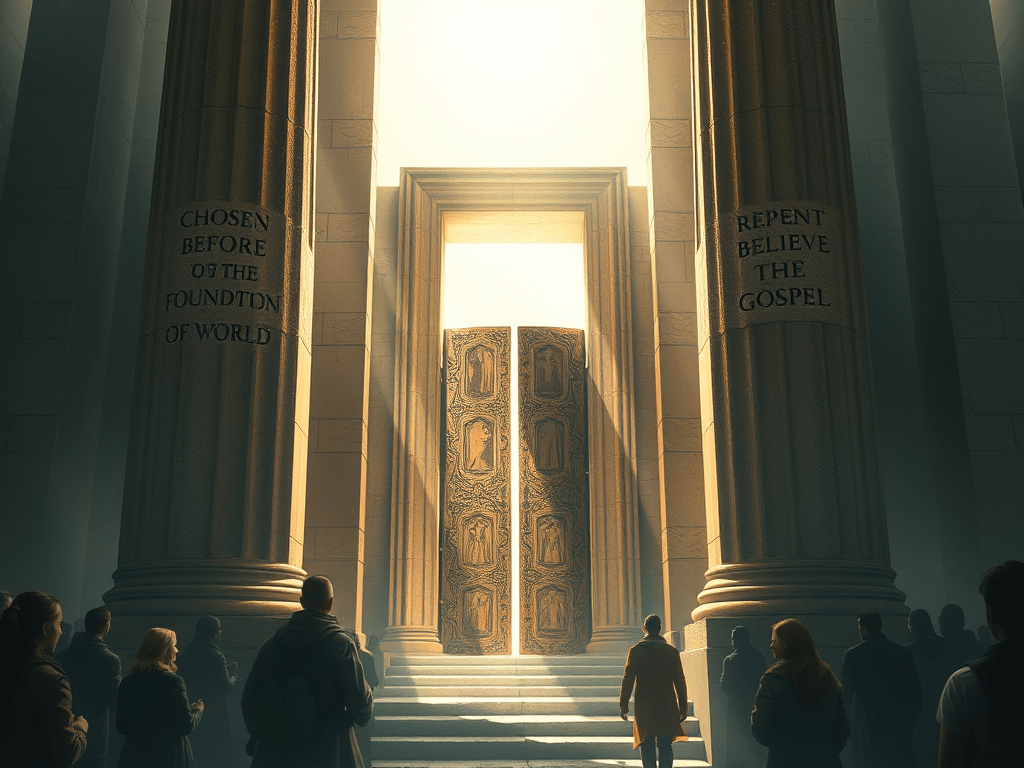
There is a door, old and narrow, on which two mighty pillars are engraved – one reads “Chosen before the foundation of the world” (Ephesians 1:4), and the other declares “Repent, and believe the gospel” (Mark 1:15). Many, standing before it, despair to walk through. “If God must choose me,” they cry, “what use is there in striving?” Others, clinging to their own strength, ignore the first pillar entirely and exhaust themselves upon the second, as if the kingdom of heaven were entered by merit. Yet the door stands firm, and the invitation remains: “Whoever desires, let him take the water of life freely” (Revelation 22:17).
This is the place where logic falters and truth transcends the narrow hallways of human understanding. For Scripture speaks with both thunder and whisper, declaring God’s supreme will, while calling man to genuine response. We are not asked to reconcile mystery by removing either pole, but to believe what is revealed and bow to the wisdom of Him who reveals it.
The Lord declares, “I will have mercy on whomever I will have mercy” (Romans 9:15), and again, “It is not of him who wills, nor of him who runs, but of God who shows mercy” (Romans 9:16). This is no cold decree, but a divine choosing rooted in love, as Jesus Himself said, “No one can come to Me unless the Father who sent Me draws him” (John 6:44). Salvation begins with God; He is the author and finisher of our faith (Hebrews 12:2). To be drawn by God is to be awakened, softened, made willing where once we were stone.
Yet the same Scriptures summon us to act: “Believe on the Lord Jesus Christ, and you will be saved” (Acts 16:31), “Repent therefore and be converted, that your sins may be blotted out” (Acts 3:19), and “Strive to enter through the narrow gate” (Luke 13:24). This is no illusion of responsibility, but a call to real response. We are not puppets, but image-bearers. The hand that formed us respects the dignity He gave us, calling us to repent, trust, surrender.
So then, what are we to make of this tension? Simply this: God is sovereign, and man is responsible; not as two opposing truths, but as two sides of the same coin. The clay is shaped by the potter, yes, but the clay must still yield. The seed is planted by the sower, but it must fall on soil that does not resist the root. The Gospel is preached, and the Spirit moves, but the man must answer, “What must I do to be saved?” (Acts 16:30).
How can this be? Consider Christ Himself. He wept over Jerusalem saying, “How often I wanted to gather your children together…but you were not willing!” (Matthew 23:37). He stood as the appointed Lamb, “delivered by the determined purpose and foreknowledge of God,” yet “you have taken by lawless hands, have crucified, and put to death” (Acts 2:23). There, at the cross, sovereignty and responsibility meet without contradiction; God ordained it, and man is guilty.
Therefore, let no man say, “If I am not chosen, I cannot come,” for the invitation is sincere. Let no man boast, “I chose Christ on my own,” for the breath with which he called was first given by God. The soul that hears the call to repent and believe has already been stirred by grace. The one who seeks has already been sought.
In the end, the paradox does not need to be resolved, it needs to be trusted. For salvation is not a riddle for us to solve, but a mercy to receive. We are told to repent, so we must. We are told that God draws us, so we pray that He would. And when we rise to find we have believed, we will fall to our knees in wonder, saying, “You did not choose Me, but I chose you” (John 15:16).
To the believer, then, let this be your peace: You are secure, for you are His workmanship (Ephesians 2:10). And to the seeker, let this be your call: Today, if you hear His voice, do not harden your heart (Hebrews 3:15). The door stands open; not by your strength, but by His grace. Walk through it.
In Christ’s service, JFH
 Seeking Truth in Today's Troubled World
Leave a comment