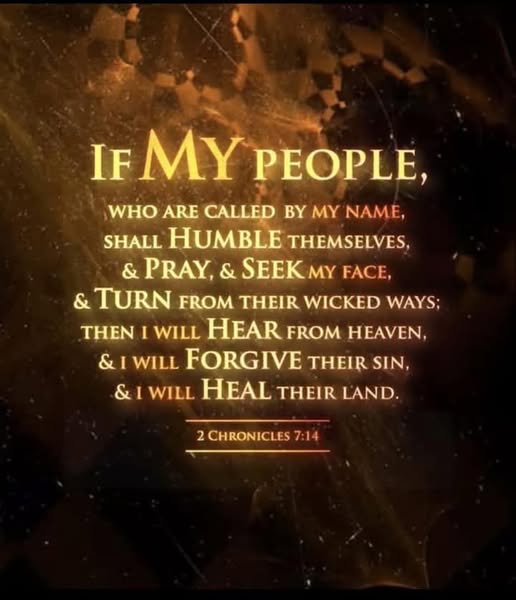
“If my people, who are called by my name, will humble themselves and pray and seek my face and turn from their wicked ways, then will I hear from heaven, and will forgive their sin and heal their land.” 2 Chronicles 7:14
Commentary on 2 Chronicles 7:14 — A Voice from the Throne
There is a majestic solemnity in this verse, a voice not of arbitrary demand but of fatherly invitation—a call not from a tyrant seeking obedience, but from a Creator longing for communion. It is not directed at the world at large, but at “My people, who are called by My name.” The implication is staggering: the possibility that the calamity or decay of a nation does not rest in the sins of outsiders, but in the complacency, pride, or rebellion of those who bear God’s name.
The command begins not with activism, nor even with public worship, but with humility. One cannot seek the face of God if one is enamored with the reflection of their own. Pride, that subtle and devastating sin, turns us into little gods of our own worlds, blind to the higher light. The Almighty, ever a gentleman, does not force Himself upon us; He waits for the soul to bow low enough to see Heaven.
“Pray and seek My face.” This is no mere recital of words. This is a posture of the heart that yearns not for the gifts of God, but for God Himself. Many seek His hand, few seek His face. To seek God’s face is to long for His presence more than His provision, His holiness more than His help.
And then comes the turn—the great pivot of repentance: “Turn from their wicked ways.” The text assumes that wickedness has crept even into the camp of the saints. This is no finger pointed outward but a mirror turned inward. For what good is it to bemoan the darkness of the world while entertaining shadows in one’s own soul?
But then, the divine promise breaks forth like dawn: “Then will I hear from heaven.” That phrase alone is enough to make the angels hold their breath. The infinite bends to listen. The transcendent stoops to hear. God, who lacks nothing, is moved by the honest cries of repentant hearts.
Forgiveness is not reluctant; it is the native language of Heaven. And healing—not just of bodies, but of land, of systems, of nations—comes in the wake of spiritual realignment. God’s healing follows holiness, not political alignment. His promise is not to perfect programs, but to restore people who repent.
Application to the Modern Christian Church in the United States
In the present hour, the Church in the United States stands at a crossroads—not because of external threats, but because of internal forgetfulness. Like Israel of old, it has at times mistaken prosperity for blessing and numerical strength for spiritual power. There is much activity, much sound and fury, but too often it signifies little of Heaven.
There is a temptation, subtle but deadly, to assume that if we preach loudly enough against the darkness outside, we will not have to deal with the darkness within. But 2 Chronicles 7:14 does not say, “If the world repents…” It says, “If My people…” The decline of a nation begins not with the rebellion of pagans but with the prayerlessness of the saints.
American Christianity has sometimes bowed more to the altars of politics, comfort, and cultural approval than to the throne of grace. The call to humble ourselves is not a call to weakness, but to return to the source of real strength. It is not humiliation but healing.
To seek His face again is to tear down idols of nationalism, consumerism, racial pride, and denominational arrogance—and to hunger for the living God. It is to fast from ego and feast on the Word. It is to rediscover not just what we are against, but whom we are called to love.
The hope for revival is not in better marketing, but in broken hearts. Not in louder voices, but in lower knees. The great need of the hour is not a louder church, but a holier one.
Application to the Cross: Calvary and the Healing of the Land
Nowhere is the rhythm of 2 Chronicles 7:14 fulfilled more completely than in the cross and resurrection of Jesus Christ.
There, at Calvary, the Son of God humbled Himself in a way no man ever has. He prayed, “Not My will, but Yours be done.” He sought the Father’s face in agony, not for personal gain, but for the redemption of all. And though He had no wicked way to turn from, He bore the weight of ours—all of them.
At the cross, God both judged sin and forgave it. Heaven did not merely hear from above—it came down. The Son cried, “It is finished,” and in that cry, forgiveness rang across eternity. The veil was torn. The way was made.
And on the third day, as He rose from the grave, healing surged like sunlight over a cursed earth. The healing of the land began there—not with political victory, but with blood-stained mercy. Redemption, not reformation, was the divine answer. Resurrection, not rhetoric.
Today, that same invitation stands: if we, His people, will humble ourselves, seek His face, and turn from our ways, then the resurrection power of Calvary will not merely save individuals but can breathe healing into lands, into communities, into cultures. The Gospel is not a footnote to 2 Chronicles 7:14; it is its crescendo.
So then, my friends, let us not wait for the world to change. Let us be the change. Let us bend low so that Christ might rise high. And perhaps, just perhaps, Heaven will hear again—and healing will come, not by might, nor by power, but by His Spirit.
In Christ’s Service,
~ JFH
 Seeking Truth in Today's Troubled World
Leave a comment