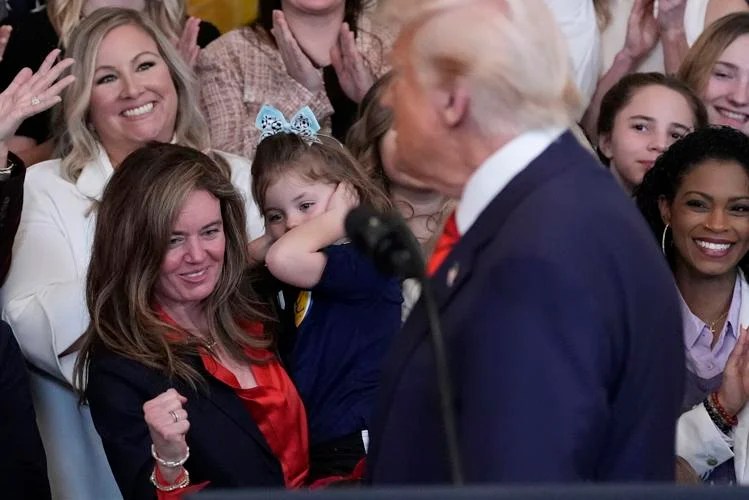
In a political climate where common sense is often treated as a radical proposition, President Donald Trump has signed an executive order titled “Keeping Men Out of Women’s Sports.” As the name suggests, this directive aims to do what once required no explanation: ensure that women’s sports remain for women. Predictably, the decision has ignited both applause from those who value fairness and outrage from those who believe that ideology should trump reality.
The executive order instructs federal agencies to enforce Title IX based on biological sex, as opposed to the more recent and nebulous concept of “gender identity.” Schools that allow biological males to compete in female sports categories now face the prospect of losing federal funding—a reminder that principles are only as strong as the consequences for violating them.
Title IX, enacted in 1972, was designed to eliminate sex-based discrimination in education, ensuring that women had the same athletic opportunities as men. The policy was never controversial in its original form—at least, not until bureaucrats and activists began stretching its meaning beyond recognition. The inclusion of transgender athletes in women’s sports has raised fundamental questions about fairness, competitive integrity, and whether decades of progress for female athletes should be undone to accommodate ideological preferences.
The previous administration, under President Joe Biden, chose to redefine Title IX by expanding its scope to include gender identity and sexual orientation. The result? Schools were placed in the impossible position of choosing between appeasing activists and upholding competitive fairness. Female athletes who spoke up found themselves ignored, labeled as bigots, or told to accept the new reality without complaint.
Meanwhile, the NCAA, under President Charlie Baker, followed the well-worn path of institutions that prefer to avoid controversy rather than uphold principle. By allowing transgender athletes such as Lia Thomas to compete in women’s events, the NCAA effectively abandoned its duty to ensure fair competition. Lia Thomas, a biologically male swimmer from the University of Pennsylvania, made headlines by winning a national title in the women’s 500-yard freestyle—an outcome that surprised no one except those who refuse to acknowledge biological differences. That a policy designed to protect women in sports could now be used to erase their competitive opportunities is the kind of contradiction only achievable in an age where feelings are mistaken for facts.
Among those who refused to remain silent was former University of Kentucky swimmer Riley Gaines. Having competed against Thomas, Gaines has been outspoken in her criticism of the NCAA’s policies, arguing that allowing biological males in women’s sports fundamentally undermines the purpose of Title IX. She and other athletes have filed lawsuits against the NCAA, asserting that it has violated Title IX by permitting transgender women to compete in female categories. While legal challenges are often slow-moving, the issue at stake is clear: either Title IX protects women’s sports, or it doesn’t.
The implications of President Trump’s executive order are significant. By restoring the definition of gender to its biological basis, the order seeks to realign policy with reality. Educational institutions now face a choice: adhere to the federal mandate and preserve fairness in women’s sports, or embrace gender ideology and forfeit federal funding. It is a decision that should be straightforward, though recent history suggests that clarity and courage are often in short supply.
Unsurprisingly, legal challenges from civil rights groups and transgender activists are expected. The debate, however, is not about “rights” in the abstract—it is about whether the rights of one group should come at the expense of another. The very concept of competition assumes differences; to pretend otherwise is to render competition meaningless.
In the end, this executive order is not a radical departure but rather a restoration of what should never have been lost: a recognition that biological differences matter in sports and that laws meant to protect women’s opportunities should not be rewritten to erase them. Whether this principle withstands the coming legal and political battles remains to be seen, but at least, for now, the argument is back where it belongs—rooted in reality, not ideology.
In Christ’s service,
~JFH
 Seeking Truth in Today's Troubled World
Leave a comment